Showing posts with label weeds. Show all posts

Wednesday, May 29, 2019

Montana, watch out for Palmer Amaranth!


Kari Lewis

Last week I had the opportunity as part of our MSU Extension Ag Agent update to visit the North Dakota State University Extension research center at Williston, ND. One of the topics covered was palmer amaranth. Palmer amaranth is a type of pigweed that originated in the desert region of the southwestern US and has since spread all across the US with the exception of Montana, Idaho, Washington, and Oregon.

Rich Zollinger, a retired NDSU Extension Weed Scientist said the following about the weed: “Palmer amaranth’s prolonged emergence period, rapid growth rate, prolific seed production, and propensity to evolve herbicide resistance quickly makes this the most pernicious, noxious, and serious weed threat that North Dakota farmers have ever faced.”

Palmer amaranth is a competitive and aggressive weed that can grow 2 to 3 inches per day in optimum conditions. Palmer amaranth can easily reach 6 to 8 feet tall, has tremendously thick stalks, and produces up to 1 million seeds per plant! It emerges throughout the growing season and is very prone to herbicide resistance. Palmer amaranth has been reported to reduce yields up to 91 percent in corn and 79 percent in soybeans.

In Nebraska where there’s issues with herbicide resistant Palmer Amaranth, it’s estimated to cost $145/acre to control the weed in soybean fields. Therefore, its absolutely critical to remain diligent in scouting for this weed.

Palmer amaranth resembles redroot pigweed, smooth pigweed, and waterhemp. However, Palmer amaranth has no hair on the plant, the petioles (or leaf stem) are longer than the leaf, the leaves are diamond or oval-shaped, and there’s spiny bracts on the female plants.

Palmer amaranth can be spread in multiple ways. It arrived in North Dakota numerous different ways – a custom combine that came up from the south, a combine purchased from Ohio, a railroad car, in millet seed, in sunflower screenings, etc. If using custom cutters for harvesting this summer, it is absolutely critical that they clean out their machinery prior to harvesting between operations.

If while out scouting your fields you suspect palmer amaranth, please bring a sample into your local MSU Extension office for identification. There is also some great resources on palmer amaranth available at www.ag.ndsu.edu/palmeramaranth.

Thanks to NDSU Extension for the tour and information!
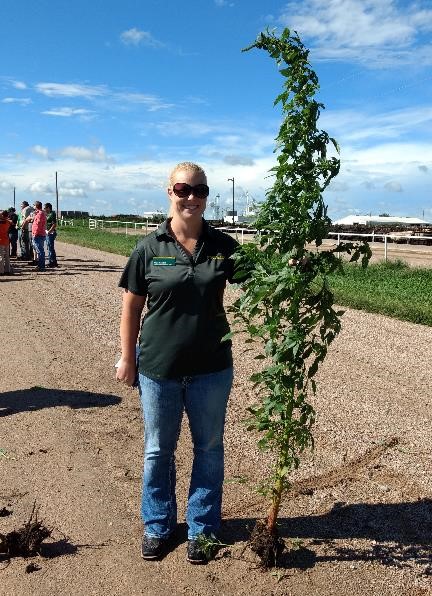


Alicia Harstad with a Palmer Amaranth Plant
Stutsman County Extension agent Alicia Harstad with a
Palmer Amaranth plant (NDSU Photo)

Wednesday, May 15, 2019

Begin management now for improved Knapweed control


Kari Lewis   

             
The purple flowers of spotted knapweed may not be showing quite yet, but most knapweed plants throughout the county are actively growing at this time.  ‘Skeletons’ of last year’s knapweed plants, the dried-out stem and flower seed heads, are a tell-tale sign of where knapweed grew last year.  Upon closer examination of the skeleton, the current year’s growth (rosette) can typically be identified.  Rosette leaves of spotted knapweed are indented or divided about halfway to the midrib.  Rosettes first initiate growth in mid-spring, plants then bolt (or produce their flowering stem) in early summer and by mid-summer the purple blooms are typically seen. 


Controlling knapweed while in the rosette stage is much
more effective than waiting until flowers appear.  Photo by Kari Lewis.

                Spotted knapweed is a Montana noxious weed that greatly decreases land productivity, forage production, and property values.  Now, while knapweed is in the rosette stage, is the time to begin spotted knapweed control.
                Regular and careful hand pulling can control spotted knapweed.  Knapweed regrowth occurs from the crowns, so the entire crown portion of the plant must be removed.  Plants can be pulled most effectively when the soil is moist.  Plants should be bagged and disposed of in a manner to prevent seed dispersal which would exacerbate the spread of knapweed.  Knapweed plants produce from 500 to 4,000 seeds per plant and seeds can be viable for up to eight years, so proper disposal of plants is critical. 
                Mowing is most effective in areas where there are healthy perennial grasses that will respond to mowing with renewed growth.  If the plant community is dominated by forbs or annual grasses, mowing may open up the plant community to further weed infestations and increase knapweed density.  Mowing early in the season can prevent seed production and lower the plant’s carbohydrate reserves.
'Skeleton's from last year's knpaweed
plants are a tell-tale sign of where to find
the current year's rosettes. 
Photo by Kari Lewis.
                Herbicides labeled for spotted or diffuse knapweed application during the rosette stage include those with the following active ingredients: Aminopyralid (Milestone), Clopyralid + 2,4D (Curtail), Picloram (Tordon 22K), or Triclopyr + clopyralid (Redeem R&P).  The herbicide 2,4-D can be applied at the early stage of bolting.  The MSU Extension publication, ‘Biology, Ecology, and Management of Montana Knapweeds’ includes herbicide application rates as well.
                Another tool in the toolbox for controlling knapweed includes biocontrols.  Biocontrols are insects that naturally feed on the knapweed plants, decreasing the plant density, plant height, and over time, plant population.  Biocontrols work best in large, dense infestations.  The Glacier County Extension Office will again be coordinating a bulk order of biocontrols.  Orders for the Larinus minutus/obtusus (Knapweed Seed head weevil) will be due June 7 ($50/carton) and orders for the Cyphocleonus Achates (Knapweed Root Weevil) will be due July 26 ($90/carton).  Shipping will be free to the Glacier County Extension Office and with the purchase of five cartons of a biocontrol species, there will be one free carton added.  Order forms are available at the Glacier County Extension webpage or by contacting the Glacier County Extension Office at (406) 873-2239.

Wednesday, September 5, 2018

What you do in the off season....Determines your winter and spring, 2019!


With the fall sports season underway, the phrase, ‘What you do in the off season determines what you do in the regular season,’ certainly comes into play.  I feel the same way about September for rural Montana.  What we do in September will determine what we do in the coming winter and spring. 
            In terms of preparing for winter, we know propane prices are lower this time of year than
Winter 2018 was one for the books, make sure
to get propane ordered, firewood cut, and
cupboards and freezers filled now.
Photo by Kari Lewis
during the dead of winter, so now is the time to get that supply ordered.  We know it is much easier and safer to access firewood now, than in the winter.  And, we know that now is the time to stock those cupboards and fill the freezer as well.  Do you remember what last winter was like??  Let’s be prepared!
              In terms of our lawn, now is the time to make those fall fertilizer applications.  In Montana, we recommend fertilizing around Memorial Day, Labor Day, and Columbus Day.  The final fall fertilizer application should occur after the last mowing of the year, but about four weeks before the soil freezes.  Therefore, by making those fall fertilizer applications now, our lawns will green up much sooner in the spring and have increased vigor.
             In terms of any newly planted trees, now is the time make sure newly planted evergreens have sun barriers on the windward and south side, and that deciduous trees have their trunks wrapped with a tree wrap to help reflect the sun, which will reduce sunscald on the bark.  Later in the fall after the leaves have turned color and fallen off, trees should be watered weekly until the soil freezes.  These fall waterings (after the leaves have fallen off) will help maintain tree health and longevity. 
            In terms of the cowherd, we know that cull cow prices are typically higher in September than they are in October or November when the dry cows hit the market.  Therefore, now would be the time to market those cull cows.  We also know that it’s much easier to put condition on a cow in the fall while she’s in the 2nd trimester, than later in the winter or right before calving.  Now is the time to body condition score those cows and sort off the young cows or thin cows to early wean their calves and provide them a little extra time to bounce back before calving.
            In terms of controlling winter annual weeds and perennial weeds, fall is a great time to do so.  Winter annual weeds, such as cheatgrass, are best managed in the early fall.  Winter annual weeds are easiest to control when air temperatures are mild, and weeds are still actively growing, generally before the first killing frost. 
Fall is a great time to control perennial weeds as cooler temperatures trigger the weed to prepare for winter by moving food reserves down to its roots, which promotes movement of herbicides to the plant’s roots and results in improved control.   Dandelions in the lawn, spotted knapweed, houndstongue, and whiteop are examples of perennial weeds that can be effectively managed in the fall.  Fall herbicides should be made only if plants still have green, pliable leaf tissues and are best done when daytime temperatures are expected to exceed 60 to 65 degrees Fahrenheit.
If you have questions on fall lawn or tree care, weed management, cowherd nutrition, food preservation, etc., be sure to contact your local MSU Extension office!

Tuesday, April 17, 2018

Ag Decision Tools

Jesse Fulbright, MSU Liberty County Extension

While you wait for the snow to clear and the ground to dry out a bit please check out the Southern Ag Research Center website for some tools that may help you once spring actually arrives.

The research centers are good resources that we all need to keep in mind, along with local county Extension offices.  At the aforementioned website you will find a link on the left hand side that says “Agronomy Decision Tools.”  It is under this link that you will find several tools that you can utilize throughout the season.  For example, in the eventuality that we ever get in the fields this spring, you might be wondering about a seeding rate.  There is a seed rate calculator link that you can follow that has you input your desired plant population on a plants per square foot basis.  You can also modify your seed weight, germination rate, purity, emergence mortality, row spacing, the size area that you are planting and the seed price.  Once those numbers are inputted it will spit out your seed rate calculations., including target plant population, planting rate, and total cost.
 
As we get into the season and are fertilizing crops there is also a fertilizer recommendation tool that you can use, if you have had a soil test done recently that you can refer to, as it asks for numbers from those tests. 

Additionally, as you spray for various weeds throughout the season and plan for your rotations over the coming year, an herbicide selection tool is there to assist you.  All you need to do is select what weeds you would like to control, what your current crop is, what your next crop is anticipated to be, when the next crop will be planted and whether the herbicide will be applied pre- or post-emergent.  This will then spit out all available herbicides for use, including what pesticide group they below to and for what weeds the chemicals will work on, if you selected for control for multiple weeds.  We aren’t making a recommendation.  We are helping you make an informed decision when you talk with your chemical dealer or professional advisor.  The only downside of this tool that I can find is that it doesn’t help with tank mixes.  For tank mixes I would still advise reading the label and visiting with your chemical representative. 
I would encourage all growers to take some time and explore the website and the tools I briefly outlined.  These can greatly help you in your yearly operations.